
- AI Image GeneratorAI Character
- AI Video Generator
- AI Image ToolsAI Video ToolsOther Tools
 AI Image Generator
 AI Character
 AI Art
 AI Video Generator
 Other Tools
- AI Image Generator
- AI Art
- AI Video Generator
- AI Video Effects
- AI Image Tools
- AI Video Tools
- Other Tools
- Start Now
7 Best AI Outfit Generators in 2026 for Virtual Styling
 SprakinsLast Updated: 2026/11/10
What can you do with an outfit generator? You might encounter this situation: standing in front of a full closet with nothing to wear; you know what you own, but you can't imagine what you have never tried.
Today, instead of guessing, you hand an outfit generator a photo or a description and get a look back in minutes. Whether that look is a flat combination of garments or a fully redrawn character in a new costume, these tools do design outfits you can wear in reality.
In this guide, we cover 7 outfit generators worth trying in 2026, from photo-based virtual try-on to character clothing swaps. Every tool was evaluated by what it actually generates, its pros and cons, use cases, and its price. The purpose is to find the right tool that can dress you up.
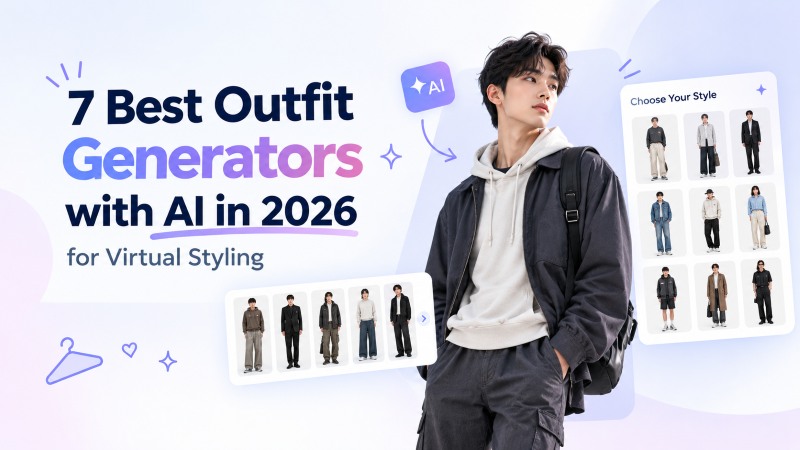
What Is an Outfit Generator?
An outfit generator is any tool that creates a wearable outfit for you instead of making you put all the clothes together. In practice, there are three main types:
- Combiners: take clothes from a list, either real products or pictures you uploaded, and put them together into full outfits, piece by piece.
- Renderers: use a photo of a person and change the clothes based on a description or a sample clothing image.
- Generators: create both the characters and the clothes from nothing.
Why Do You Need an AI Outfit Generator?
Save Time
Usually, trying on clothes takes up a lot of time. Because you have to drive to the store, wait for a fitting room, change in and out of outfits several times, and then do it all again at another store.
That can take up most of your time just to try on clothes. With a generator, you get a base photo of yourself, upload it, and the full outfit shows in minutes.
Experiment with Different Styles
Stock limits what you can find when shopping. Stores only offer what they choose for the season, so your options depend on the seller’s choices.
Generators don’t have these limits. Some people are very busy, and they have no time to try on outfits one by one. An outfit generator can create a style suits before they spend any money.
Make Outfit Decisions Easier
Decision fatigue when it comes to getting dressed is real, and it often happens because there are too many good options. Generators help by turning the open question of what to wear into a simple choice between a few outfits.
Some tools go further, letting you plan ahead, assign outfits to certain days, view your whole month, or share two options with a friend so they can help you decide.
Reduce the Cost of Special Occasion Outfits
Occasion wear usually gives you the worst value for money in your wardrobe. Outfits for weddings, birthdays, Christmas parties, or formal events often get confusing.
With an outfit generator, trying out these looks online helps you see which shapes, colors, and fabrics suit you before you buy, so you can spend on one outfit you really like instead of buying several. Plus, you can show your favorites to the people whose opinions matter most before the big day.
7 Best Outfit Generators Worth Trying in 2026
1. CharaLab — Best Outfit Generator for AI Characters
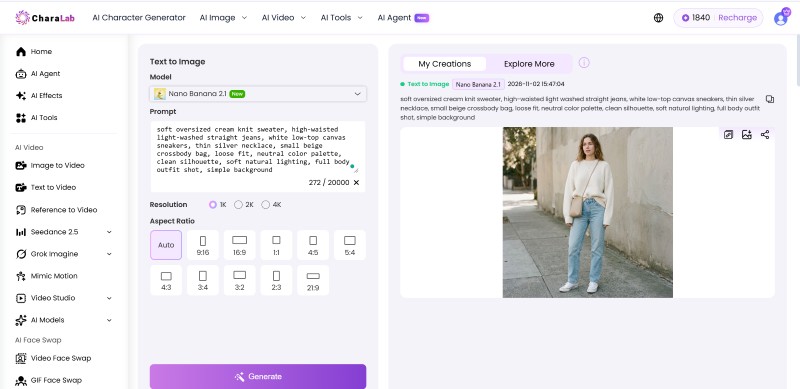
CharaLab is the best outfit generator for AI characters rather than a styling app, and that is why it belongs on this list. When other tools are limited by reality, CharaLab lets you invent the wearer for your character.
Its dedicated AI Clothes Changer tool handles tops, bottoms, dresses, and accessories, and can easily recolor or swap out garments. This is helpful if you like the shape of an outfit but want a different color. Meanwhile, its AI character generator supports styles like realistic, anime, cartoon, 3D, fantasy, superhero, and Ghibli art; you can dress one character in 20 different ways.
Key Features
- Prompt-based Clothes Changer: Describe the target outfit; the AI handles the clothes and background, so no manual skill is required
- Outfit Control: Your tops, bottoms, dresses, and accessories can each be changed independently
- 20+ Character Styles: The same reference image can be turned into 20+ outfit styles, which give you more ideas
- Multi-ratio Export: Outputs at 1:1, 9:16, 16:9, 4:3, 3:4, 3:2, or 2:3, meaning one look can be used as a daily outfit or occasion outfit
- AI Character: CharaLab offers plenty of character templates to choose from, so you can make your outfit stand out
Pros
- Free tier plus daily free credits
- Entire outfit generation in one place
- Commercial usage rights are supported
Cons
- A weak result means rewriting the prompt
- Output quality depends heavily on the source photo
Use Cases
- Character designers
- Concept artists
- Tabletop game masters
- Manga creators
Pring Plan
- Free trial is available
- Pay-as-you-go plan
2. Pinterest — Best Random Outfit Generator
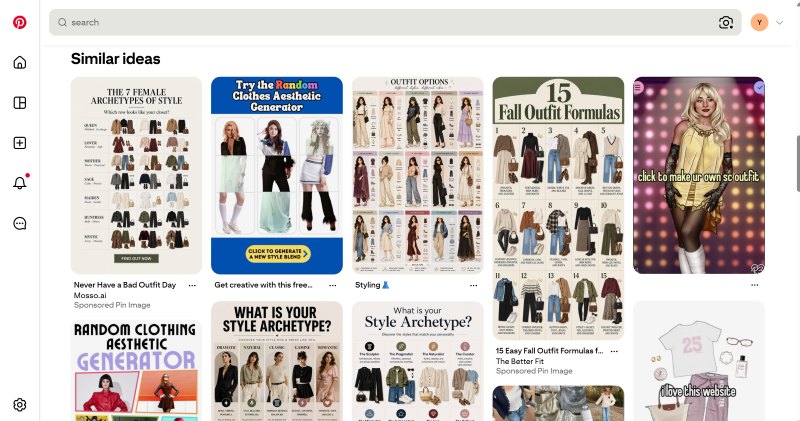
Pinterest is more like an outfit generator hub for random matches than an AI-powered generator, and it is important to know the difference before you spend time on it. There is no prompt box, no upload button, and no generate step; what you see is what other people saved.
That is also the point. Because the site collects real Pins, it works as a live directory of what people actually save. It also acts as a connection point, and many of those Pins link to other outfit generator sites, style blogs, and store product pages.
Key Features
- Random Outfit Hub: You can find any outfit styles here
- Search for More Ideas: One seed concept branches into dozens of adjacent aesthetics
- Real Photographs: The pool consists of Pins from real creators and retailers, giving you reliable examples
- Save to Boards: Collect single items or whole ensembles into boards
- AI-powered Outfit: The platform automatically combines saved fashion items into complete looks
Pros
- Completely free
- Source material is real
- Many Pins point straight to third-party generators
Cons
- Poor customization features
- The pool is too messy
- Does not have enough intelligence
Use Cases
- Fashion editors
- Trend forecasters
- Art directors
- E-commerce merchandisers
- Costume designers
Pricing Plan
- Completely free
3. YouLookFab — Best Outfit Generator for Fashion Trends
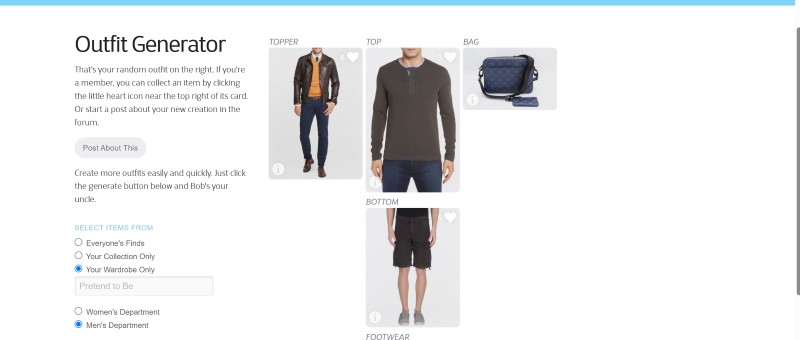
YLF is a long-running outfit generator for fashion trends with a community attached, and its fashion outfit generator reflects an assortment put together from real retailers, updated with current market prices.
Its outfit generator clearly displays the whole outfit and details. As the screenshot shows, topper, top, bottom, and bag are listed one by one. Each outfit card carries the product name, direct link, current price, and members can save an item to their finds list.
The real value of the site is that it offers almost daily editorial posts about trend reports, seasonal styles, and outfit ideas you can reuse.
Key Features
- Fashion Trend Prediction: Here you can find all the trending fashion designs, from the past and present to the future.
- Direct Buy Links: Save an item to your finds list, and YLF notifies you when the price moves
- Daily Editorial Content: Trend reports, seasonal direction, and reusable outfit formulas written by someone who has bought the collections professionally.
- Community Communication: Members post photos of themselves in a look and get substantive feedback
Pros
- You can actually purchase
- Browse without any account
- Unlike a random combiner, YLF explains why a trend is happening
Cons
- There is no AI to optimize
- Ignores body type, height, proportions, weather and occasion
- Photo visibility is limited by member level
Use Cases
- Personal stylists
- Fashion journalists
- trend writers
- Retail buyers
Pricing Plan
- Browse for free
- Purchase for a fee
4. OutfitMaker.ai — Best Outfit Generator for AI Suggestions
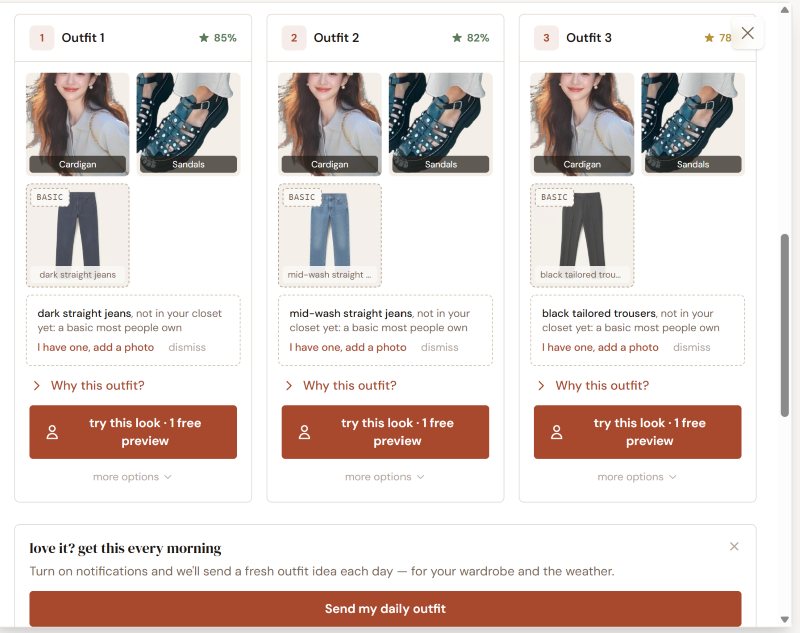
OutfitMaker is a wardrobe-first outfit generator with AI suggestions. The entire product workflow lives in a browser; it keeps working offline with what you have already cataloged.
Each morning, the tool suggests a full outfit from your wardrobe, considers the weather, and provides a matching outfit. There’s another feature — Look Preview, which shows your suggested outfit with different skin tones and body shapes in about 20 seconds.
Key Features
- AI-Powered Processing: AI can remove the background and tag it by category, color and style automatically
- Weather Daily Suggestions: Adjusted for the local forecast and whatever is actually on your schedule
- Model Look Preview: Render the outfit on a model in under 20 seconds
- All Workflow in One Place: Compare a single base piece against several alternatives
Pros
- Get unlimited suggestions from AI
- The pricing options fit different needs
- Data handling is explained clearly
Cons
- It cannot create an original design
- The product is still new and has a limited presence
Use Cases
- Hybrid and remote office workers
- Capsule-wardrobe builders
- Wardrobe consultants
- Digital nomads
Pricing Plan
- Premium plan: €7.99/mo
- Week plan: €1.99/mo for 7 days
5. Ask My Wardrobe — Best Outfit Generator for Comparing Different Styles
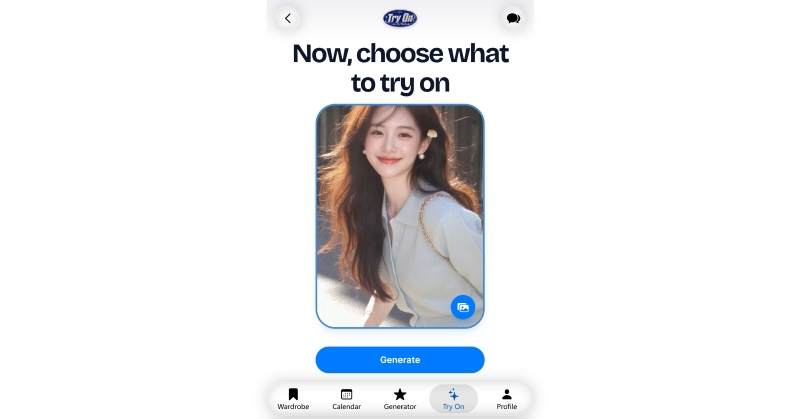
Ask My Wardrobe is the most direct tool for comparing different styles: upload a photo of yourself, upload the garment you are considering, and see how the two look together before you buy.
In addition to the comparison feature, there’s a free online outfit planner. You can plan outfits for each day, whether it’s for work, holidays, dinner, weekends, events, or dates. Once the outfits are ready, save them in your personal lookbook, and you can send any look as a private, shareable link to others.
Key Features
- Compare Different Styles: Generate multiple versions and judge them step by step
- Virtual Try-on: Combine a photo of yourself with an image of any garment
- No Sign-up Entry Point: Start with free attempts immediately, and only create an account when you want to save looks
- Monthly Planner with Real Calendar: Schedule your looks for specific days, and add your plans to Apple, Google, or Outlook calendars
- Private Shareable Links: You can send one look to trusted friends for feedback
Pros
- Keep consistent background, light, and aspect ratio
- No account barrier
- Smoother workflow in a clean main page
Cons
- Read the terms before uploading anything you did not create
- Results give you a general idea, not a precise prediction
- You need a clear full-body photo and a clean garment image
Use Cases
- Online resellers
- Second-hand sellers
- Remote personal stylists
- Small store owners
- Wedding guests
Pricing Plan
- Totally free
6. CapCut — Best AI Outfit Generator for AI Design
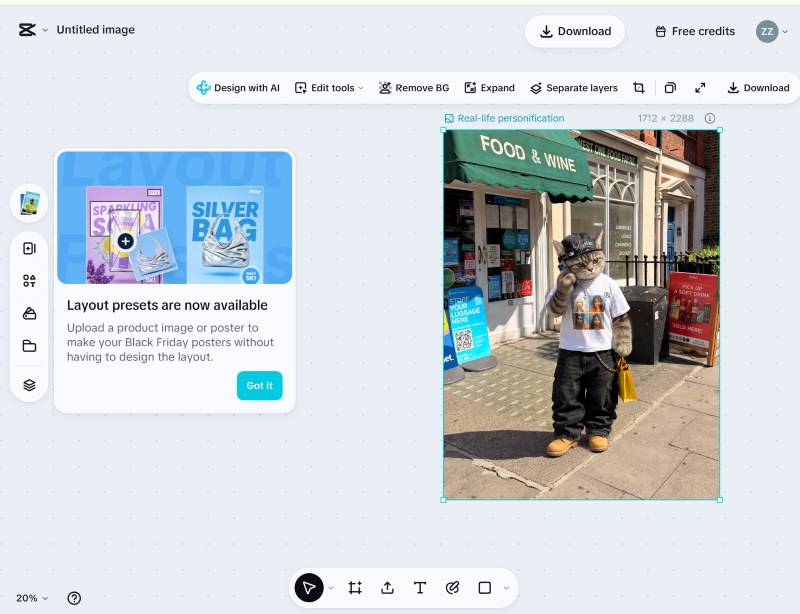
CapCut's outfit generator is not a product; it is the AI design function inside CapCut's creative suite. To use it, open the AI design tools and describe the look you want in a short prompt. If you want a specific garment, you can upload a photo as well.
The tool covers a wide range of outfit styles, including tailored suits, cocktail dresses, streetwear, and tuxedos, which allows creators to get inspired designs from AI. Plus, another advantage is the control you have after generating an outfit, like changing the outfit's details, adjusting the fit, adding jewelry or sunglasses, or removing a jacket.
Key Features
- AI-Powered Design: You can describe any outfit in a word to see it on your AI model
- Refinement without Leaving: Once you have your first render, you can use more prompts to adjust the details without starting over
- Built-in Editing Toolkit: This lets you finish your concept image without needing another app
- Publish-ready Output: Pick image quality and file format. Download your image and share it directly to social platforms
- Shared Ecosystem: CapCut offers powerful features. Since the same suite handles editing, music, subtitles, effects, and voice
Pros
- Ready-to-use prompt examples
- Watermark-free export
- One asset can become an outfit-transition video
Cons
- Consume credits quickly
- A first-time user faces a genuinely large learning curve
- The output is only a concept image
Use Cases
- Direct-to-Consumer brand owners
- UGC creators
- Fashion photographers
- Art directors
Pricing Plan
- Free credits
- Pro Plan: $19.99/mo
- Ultra Plan: $19.99/mo
- Teams Plan: $2.5/mo
7. Canva — Best Outfit Design Tool with Templates

Canva stands out here as a template supplier, and it’s worth mentioning why: outfit work isn’t just about trying on clothes. Sometimes you might need to make a lookbook, a hang tag, or a Shopify banner. For these purposes, Canva is simply faster than tools made just for generating outfits.
Its template gallery is fully editable with drag-and-drop features. Not only for images and videos, but also for fonts, graphics, and audio, thus Canva could be seen as an overall digital tool.
Key Features
- Thousands of Outfit Templates: A large library with product mockups, labels, lookbooks, and storefront creatives for reference
- Full Design Environment: Browser-based editor that works well on both desktop and mobile
- Print-Ready Assets: Order printed outfits directly from the editor
- Collaboration and Brand Control: Invite others to work on the same file, and keep your design consistent with Brand Kits available on paid plans
- One-click Multi-format Resizing: Turn one clothing design into versions, all without having to redo the layout by hand
Pros
- It's flexibility in creative outfit design
- Works identically on mobile and desktop
- Print-on-demand fulfilment
Cons
- No smart clothing features
- Some advanced functions are only available with paid plans
- It struggles to handle professional printing jobs
Use Cases
- Print-on-demand sellers
- Fashion marketers
- brand coordinators
- Fashion students
Pricing Plan
- Free plan
- Pro plan: $144/mo
- Business plan: $250/mo
- Enterprise plan: Customization
Best AI Outfit Generators in 2026: Ranked and Compared
Here, we compare the best 7 tools' main features from the detailed description above:
| Generator | AI-Powered | Virtual Try-on | Customization | Clothing Catalog |
| CharaLab | Yes | √ | Yes | × |
| No | × | No | √ | |
| YouLookFab | No | × | Yes | √ |
| OutfitMaker | Yes | √ | Yes | √ |
| Ask My Wardrobe | Yes | √ | Yes | × |
| CapCut | Yes | × | Yes | × |
| Canva | Yes | × | Yes | √ |
Which Outfit Generator Is Best for You?
Creative Designers
As a creative designer, the real question isn’t what you wear, but what your guest wears. Designers usually face plenty of tasks during fashion holidays; the focus shifts from styling to production, and an outfit generator needs to create multiple outfit versions for their use.
In this situation, use CharaLab when you need massive outfit production. Pick Canva only if your client wants photography instead of illustration.
Fashion Content Creators
For a fashion content creator, this role is judged by how much content you make and how well your character performed on the stage. It's important for fashion workers to think of new outfits rather than outdated clothes.
Learning to combine different tools might produce unexpected results. For example, browse your preferred style on Pinterest, crop the outfit in Canva, and use the video editing tool in CapCut; then you can create a smoother workflow.
Everyday Commuters
For daily commuters, the main goal is to put together outfits from the clothes they already have. Tools that only use AI to create virtual outfits aren’t useful for this, so the tools recommended below are all made to work with your current wardrobe.
- YouLookFab: If you are ready to spend time adding your clothes, this is the most suitable choice.
- OutfitMaker: It’s the only one that considers your schedule and local weather.
- Ask My Wardrobe: It was made for specific situations, like parties, weddings, and holidays.
CharaLab, CapCut, Pinterest, and Canva might not be suitable for this role.
Special Occasions
The rules for what to wear at special occasions usually depend on many aspects:
- Attending a wedding: Use Ask My Wardrobe to help you decide, and generate a private link to share with your friends
- Your own wedding: If your wedding has a fantasy, cosplay, or other special theme, CharaLab is a great tool
- Birthdays and themed parties: An AI-powered outfit generator can be helpful
- Formal dinners and grand occasions: Tools like YouLookFab and OutfitMaker give style advice based on the clothes you already have
Regardless of the occasion, one core principle always holds true: it is crucial to compare options carefully.
FAQ
How Do I Create Good Outfit Generator Prompts?
Be specific about the outfit before describing the details. Tools work best when you list the shape, fabric, color, and occasion together. Also, mention the setting and the aspect ratio you plan to use, because a 9:16 vertical and a 16:9 landscape can make the same look appear very different.
Can I Use AI-Generated Outfits for Commercial Projects?
Yes, in most cases you can, but you should check the policy for each situation. Usually, the main risk is not the generated image, but what you put in. If you upload a photo of a real person, there could be issues with likeness rights.
What Is the Best AI Outfit Generator?
There isn’t a single best tool, since each one serves a different purpose. If you want to dress original characters in a range of artistic styles, CharaLab is the most capable. For marketing visuals, Canva has the broadest style options. If you’re deciding what to wear tomorrow from clothes you already own, OutfitMaker is more useful.
Which Outfit Styles Can I Try in CharaLab?
CharaLab's character pipelines support a wide range of art styles, including realistic, anime, cartoon, 3D, fantasy, superhero, and Ghibli. With its clothes changer, you can describe any outfit you want, so any style can be realized in it.
Does Generating an AI Outfit Cost a Lot?
All the tools mentioned in this article offer a free trial, either through a credit-based system or a limited number of free tries, making them much cheaper than trying on clothes in person. The real way to save money is to avoid unnecessary buys, like reducing online shopping returns or stopping repeated purchases of certain types of clothing, since these costs often add up to more than the total cost of using these tools a few times a year.
Conclusion
Each tool here earns its place by solving one slice of the outfit problem better than the others.
- CharaLab is the only tool here that lets you create both the character and their clothes, keeping that character consistent through 20+ different outfit versions.
- Pinterest and YouLookFab are unbeatable free sources of real information; there are actual clothes, real prices, and real trend context.
- OutfitMaker is the best helper for everyday dressing because it doesn’t create anything new and only uses what you already have.
- Ask My Wardrobe gives the clearest answer to the question of what to buy.
- CapCut and Canva take care of everything after the outfit is made.
Try these outfit generators, describe the outfit you have in mind, match the styles you prefer, and see what comes back.
 10 Best 3D Character Creator Tools in 2026(Reviewed & Ranked) >>Which is the best 3D character creator in 2026? Simply follow the comparison of 10 tools based on features and pros/cons, to find the right tool for your work. >>
 8 Best OC Generator for Consistent AI Characters (2026) >>Are you searching for the best OC generator? This guide compares the 8 best OC generators, which will help you choose the right one for your consistent OCs. >>
 6 Best DnD Character Creators from a Beginner's Perspective >>Looking for the best dnd character creator in 2026? This guide lists the 6 best creators for new users in DnD. >>
 8 Best AI Pet Portrait Generators for Pet Owners in 2026 >>Searching for the best AI pet portrait generator for your cute pet? Simply follow this guide to choose a dedicated pet portrait generator. >>
 7 Best Graffiti Generators for Creative Works in 2026 (Tested and Ranked) >>Discover the 7 best graffiti generators in 2026 to create graffiti art, logos, fonts, and tags. Compare tools and find the right one for your creative needs. >>
 Mascot Generator: How to Create Your Own Mascot with AI in 2026 >>Learn what a mascot generator can do, explore popular mascot styles, and discover how to create your own custom AI mascot with CharaLab in 2026. >>
He is an experienced expert in AI character creation and has led the early design of many virtual character products. His step-by-step guides help creators build the AI character online from scratch. Here, he turns complex character prompts into different character styles, helping every human-machine collaboration get closer to the perfect character you imagine.